

7 Reasons Australian Fleets Could Be Missing Out on Fuel Tax Credits
Updates as of June 2026
Since January, there have been several developments to the HVNL amendments within the industry that you should be aware of.
In May 2026, ministers approved the final legislative package for the updated HVNL, including the Heavy Vehicle (Mass, Dimension and Loading) National Amendment Regulation 2026 and four Statutory Instruments: Ministerial Guidelines for heavy vehicle accreditation, Safety Management System (SMS) Standard, National Audit Standard, and Ministerial Standard for alternative compliance hours.
Together, these instruments complete the legislative framework required to support implementation of the updated law. The updated HVNL and associated instruments will commence on 1 August 2026.
NHVAS to HVA
As a transport operator in Australia, especially the east coast, some or all of your trucks (and drivers with relation to fatigue) may have accreditations to mass, maintenance or fatigue under the NHVAS scheme already. With the HVNL amendments, the existing National Heavy Vehicle Accreditation Scheme (NHVAS) will be progressively replaced with the new Heavy Vehicle Accreditation (HVA) scheme. Under the HVA, a tiered accreditation framework will be introduced and comprises of the General Safety Accreditation (GSA) and the Alternative Compliance Accreditation (ACA), which were previously outlined in the original article below, where audits and SMS’s will be required.
- The NHVAS maintenance accreditation will be replaced by a new Maintenance Assurance Program (MAP), provided under the GSA
- The NHVAS mass accreditation will be replaced by the Alternative Compliance Accreditation (ACA) – Mass
- The NHVAS fatigue accreditation will be replaced by the Alternative Compliance Accreditation (ACA) – Fatigue
Find out more about the Heavy Vehicle Accreditation scheme here >
Fatigue Accreditation
While standard hours remain unchanged, for operators looking for flexibility beyond those will be introduced to the Alternative Compliance Accreditation (ACA) for Fatigue, which forms part of the GSA, and replaces the existing BFM/AFM under the current NHVAS. For existing operators already in the NHVAS, after a transition period, you must make the move to the new ACA-Fatigue Templates/Tables, otherwise drivers must revert to standard hours once expired.
Once the new HVNL bill is in effect, no new permits for NHVAS will be allowed and must apply to the new accreditations. Existing NHVAS applicants have the ability to maintain their existing NHVAS accreditation by applying for extensions prior to the HVNL bill commences:
- If your accreditation expires before the end of 2026, you can maintain your NHVAS accreditation by up to two years by applying for an extension
- If your accreditation does not expire in 2026, you can maintain your NHVAS accreditation for a further year by applying for an extension
This allows you to transition to the new regime overtime, without the expectation to immediately comply to the new standards from day one, but requires some foresight in applying for extensions before August. Otherwise, operators have the ability to transition immediately to the new ACA accreditation when ready after the HVNL bill is in effect, but that means a little bit of work.
Before applying to the ACA-Fatigue templates or tables for flexible fatigue hours (that replaces the BFM/AFM), operators must apply to the GSA (General Safety Accreditation) and have to prove risks are identified, controlled, monitored and reviewed in their SMS (Safety Management System). Once this is completed, operators can either choose from 10 ACA-Fatigue templates that provide flexibility and cover around 97% of fatigue requirements, or apply to create their own ACA-Fatigue table, which is subject to assessment.
Exemption hours are a further level beyond the templates and tables and apply to work and rest hours that aren’t standard and are bound to outer limits, which refers to the limits placed on the NHVR by law in which they can approve – like solo drivers 15.5 hours of work and minimum of 7 hours rest in a 24 hour period). Please note, operators can run on multiple templates and tables that they apply and approved for.
Written Work Diary
To ensure that the HVNL amendments that take place from August 2026, the written work diaries available (after existing stock depletes) have been updated. These changes include:
- All definitions updated throughout the work diary to match the amendments
- Ability to select Alternative Compliance Hours (ACH)
- The following fields are now optional to complete:
- Marking the day of the week
- Marking standard hours
- Recording work & rest totals
Further to this, drivers are no longer required to return a lost or stolen work diary as long as the diary is reported and the all remaining pages (if recovered) are cancelled.
Unfit to Drive & Fatigue
When considering fatigue, there is the incorporation of the ‘unfit to drive’ duty as specified by the HVNL amendments. A person must not drive a heavy vehicle – now defined as a vehicle >4.5t – on a road while they are impaired by fatigue or unfit to drive. This expands on existing duty and recognises a person’s health (both physical and mental) and fitness, not just fatigue, that are not sufficiently in good health to drive a heavy vehicle safely.
This may be due to health conditions, permanent and temporary, like illness, injury, or the effects of alcohol or other drugs. The duty legally empowers drivers to not drive if their health affects their ability to drive safely. What does this look like?
- A medical episode or adverse change in medical condition – a hypoglycaemic episode (low blood sugar) in a person with diabetes that causes weakness, shaking, dizziness or light-headedness
- Being psychologically or emotionally distressed – a distressing event at home (family conflict or distressing news) that leads to inattention, impaired judgement or reduced situational awareness
- Side effects of or adverse reaction to medication – an adverse reaction to a new medication that causes reduced alertness, slowed reaction times or impaired coordination.
Please note, there are a few areas that aren’t changing you should be aware of:
- Drivers and operators must still manage fatigue and have a duty to ensure that driving is not undertake when impaired or unfit to drive
- All Chain of Responsibility (CoR) parties must still ensure safety of transport activities
- Heavy vehicle licencing will continue to be managed through state departments
- Work health & safety laws and their obligations under WHS legislations
Find out more about Unfit to Drive here >
Mass, Dimension and Loading
Under the HVNL amendments, several changes within the Mass, Dimension and Loading are made to reduce complexity, allow more consistent access arrangements and boost productivity. The Heavy Vehicle (Mass, Dimension and Loading) National Regulation (MDL) will be amended to allow for the prescribed general access mass and vehicle length limits following the HVNL amendments.
The existing Concessional Mass Limits (CML) will be removed and replaced by the General Mass Limits (GML), in which under the reform, are updated to match previous CML mass limits – these are general access and mass management will not be required. Further to the increase in mass limits for GML, is an increase to vehicle length limits from 19m to 20m to reflect modern vehicle configurations, improving productivity while maintaining safety performance.
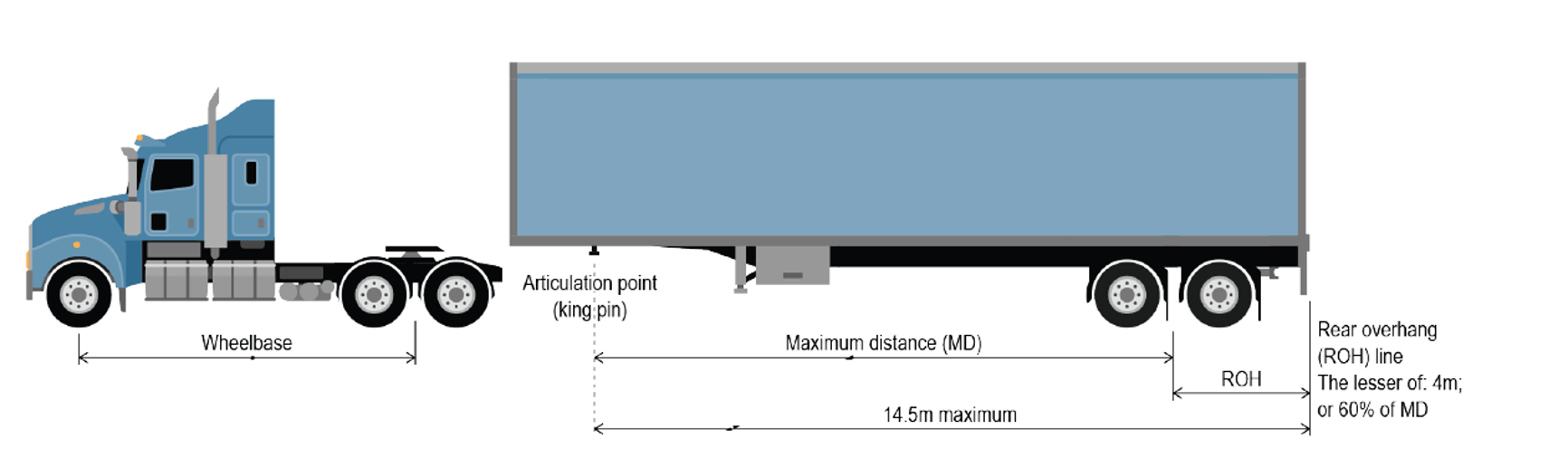
Figure a: Diagram outlining the semi-trailer wheelbase and trailer length maximum distance as sourced from the NHVR’s HVNL industry webinars in May 2026
Along with this, tag trailer mass ratio increase from 1:1 to 1:1.3, with minimum requirements on the steer axle of 20% of the sum of the actual truck mass (or according to manufacturer’s ratings).
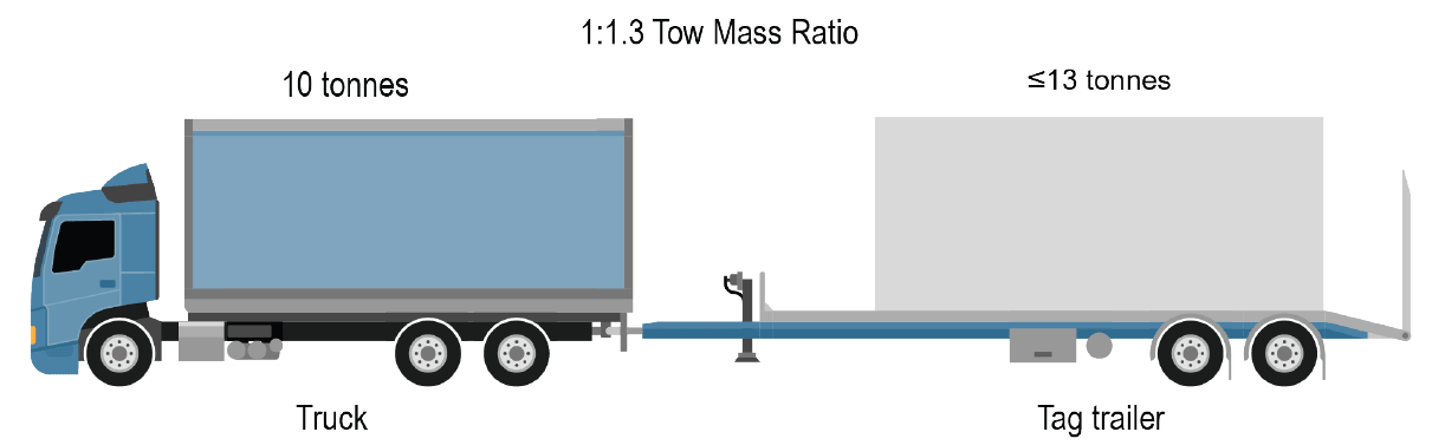
Figure b: Diagram outlining tag trailer ratio increase as sourced from the NHVR’s HVNL industry webinars in May 2026
Lastly, Euro VI concessions have expanded to include road trains to allow for a transfer mass from the steer to the drive axle.
For further access to higher mass limits, operators must enroll in the ACA-Mass, which replaces the NHVAS Mass accreditation, under the GSA. Similar to NHVAS Fatigue accreditation, operators can extend their existing accreditation (prior to August 2026 commencement of the HVNL amendments).
- If your accreditation expires before the end of 2026, you can maintain your NHVAS accreditation by up to two years by applying for an extension
- If your accreditation does not expire in 2026, you can maintain your NHVAS accreditation for a further year by applying for an extension
Please note, as the CML becomes the General Mass Limits (GML) and no accreditation is required for this, operators may no longer require their NHVAS Mass accreditation, thus the new ACA-Mass applies to certain notices and schemes as listed on NHVR website.
Reach out to the NHVR for clarification if any of this applies to you. You can find out more about Mass, Dimension and Loading here >
Maintenance Accreditation
Alternative Maintenance accreditation will remain as the Maintenance Assurance Program (MAP), whereby operators with Maintenance accreditation will be exempt from annual vehicle exemptions in applicable states only (QLD and NSW only). Access to Maintenance will be provided through obtaining GSA and meeting additional maintenance related requirements (similar to an ACA).
Auditing & Statutory Instruments
The NHVR is actively preparing for the implementation of the amended law, to ensure a smooth transition for industry and regulatory partners.
The NTC (National Transport Commission) and NHVR have now released key statutory instruments supporting the amended HVNL, following Ministerial approval of the final legislative package in May 2026.The instruments provide the detailed standards and guidance that underpin the amended law, covering accreditation, fatigue management and safety assurance.
Auditors approved to conduct audits under the National Audit Standard (NAS) against the standards for Safety Management Systems (SMS) Standards will be required to use the PSOE (Present, Suitable, Operating and Effective) audit method from the 1st of August. This is in contrast to auditing under the NHVAS, where risk is managed against specific modules (Mass, Maintenance, Fatigue). With the HVA scheme, you’re auditing against a business SMS, meaning all safety, operational and compliance activities are audited, including elements of maintenance, mass and fatigue.
Read the statutory instruments:
- National Audit Standard For Heavy Vehicle Accreditation (PDF, 518KB)
- Ministerial Guidelines for Heavy Vehicle Accreditation 2026
- Safety Management System Standard 2026
- Ministerial Standard for alternative compliance hours
Find out more about HVA for Auditors here >
Safety Management System (SMS) Standards
According to the HVNL amendments, operators seeking accreditation must establish and implement an SMS that complies with standards, which form a set of policies, systems and procedures relating to safety in activities conducted in driving heavy vehicles. Please note, the SMS must identify, assess and specify controls for public risks associated with these transport activities and must comply with standards and addressed using the PSOE methodology.
Businesses need to show commitment to the SMS standards and its audit requirements through a crafted SMS specific to their operation and risks involved. As each business and its work is different, there is no ‘one-size fits all’ methodology that can be used. With or without telematics, your SMS bust identify, assess and specify risk and its mitigation. More importantly, having telematics without utilising within these processes won’t hold up in an audit or during an investigation.
Find out more about Safety Management Systems here >
Please note, all the information provided is accurate as of 01 June 2026 and is subject to change. All details are provided as information to the industry, please refer to the NHVR if you have further questions on how your specific requirements may change based on your approved permits/accreditation, etc.
January 2026
Operating heavy vehicles across Australia's eastern seaboard is changing. The transport sector has transformed dramatically over the past two decades, and operators must maintain constant vigilance to ensure safe, compliant operations amid evolving business models, shifting government requirements, a greater focus on safety and sustainability (ESG), and rapid technological innovation.
As technology reshapes the industry, regulations must evolve too, becoming clearer, more streamlined, and fit for the future. The Heavy Vehicle National Law (HVNL) Amendment Bill 2025, introduced in the Queensland Parliament and set to be adopted by relevant states and territories, aims to modernise safety and compliance requirements, reducing regulatory burden without compromising robust standards.
Why is the HVNL changing?
The objectives are straightforward: improve safety outcomes, streamline compliance, and reduce red tape. The bill implements key recommendations to keep the national law responsive to industry and community needs, while giving operators more flexibility in how they demonstrate compliance.
At the centre of the reforms is an enhanced accreditation framework that strengthens the National Heavy Vehicle Accreditation Scheme (NHVAS) and makes Safety Management Systems (SMS) a core, auditable requirement. These SMS’s are required to demonstrate compliance with prescribed requirements such as fatigue work and rest hours or general mass limits.
What do you need to know? The Amendments to the HVNL bill bring four major changes that you should know about.
1. From Schemes to Accreditations
Under the current HVNL, there are four schemes that cover areas of compliance including fatigue, mass and maintenance, under what’s known as the NHVAS. With these amendments, it simplifies the framework that is the NHVAS into two main accreditations instead of four.
- General Safety Accreditation requires operators to implement a comprehensive SMS that outlines risks (internal and to the public) and controls to mitigate them. This must comply with standards that are aimed at improving the ability to meet primary obligations, the SMS framework, train staff, perform regular audits and more.
- Alternative Compliance Accreditation allows operators to deviate from standard requirements by providing flexibility to manage custom fatigue work/rest hours or mass limits if they meet prescribed safety standards. Operators must also have General Safety Accreditation to apply.
The SMS is intended to cover risk your operation faces, that can be identified through the code of practice and your experience, that then identifies controls to mitigate those risks to prevent hazards from occurring to staff and the public. While the code of practice is designed to help identify the potential risks out there, you’re expected to put together an SMS that reduces risk in areas your business has to approved standards. Your next step is to conduct an audit.
2. Audits Audits Audits
With the increased focus on SMS, audits will be required to ensure corroboration. This change will allow audits conducted by approved auditors to be used as evidence in prosecutions for breaches of primary safety duties, previously not automatically admissible in court.
This presents an opportunity for operators who have a well-documented SMS and complete audits as part of their defence to support proceedings as it helps to demonstrate proactive risk identification and safety management. If your SMS is comprehensive, has been audited, and put into practice, you will benefit from a safer and more responsible workforce.
It’s important to note that audits must be conducted by approved auditors and must be thorough in their documentation to ensure their value. During prosecution, this means you can formulate a defence with these audits as evidence for the particular risk or issue being investigated.
3. Driving while ‘unfit to drive’
Ensuring drivers manage their fatigue is key to the amendments. As part of the changes, there will be a new reference that expands on existing obligations for drivers not to drive while impaired by fatigue. This is referred to as ‘unfit to drive’ and applies to all drivers of heavy vehicles over 4.5 tonnes (not just those operating fatigue-related vehicles over 12 tonnes), to place a proactive responsibility to manage health and fitness.
While the onus is on the driver, the ‘unfit to drive’ reference is a shared responsibility that covers a broader range of situations such a as physical illness and injuries, general and mental health issues, substance use and other factors that may compromise safety. It’s important for employers to invest in updating policies and practices to improve wellbeing, including taking appropriate action to reduce impairment to driving safely for their drivers.
Beyond that, it’s even more important for employers to just get a better understanding of their drivers and their fitness for duty. Be aware that penalties will increase based on the seriousness of the offense, and officers (such as NHVR officials or police officers) have authorisation to stop a vehicle if it perceives that the driver is ‘unfit to drive’.
4. Codes of Practice
The NHVR issue timely guidance on risk and risk management practices with regard to the meeting and complying with HVNL and SMS duties, known as the Codes of Practice. It will significantly simplify the process by shifting the responsibility for initiative the development of codes from the industry to the regulator that is consistent with other safety regulators.
In the recently release codes, the NHVR provide a source of information concerning safety in transport and logistics by providing guidance on managing hazards and risks, assessments, and controls. For more information on the Codes of Practice, check out the NHVR website.
The changes to the HVNL give the industry more flexibility to achieve better safety and compliance, while also removing duplicates, simplify regulations, and modernise how the regulator operates. Although ministerial directions are stronger, operators will have more freedom to choose how they meet requirements, which can make compliance and safety practices simpler.
While the shift to more prescriptive details will be managed by each operator, it’ll allow for a more agile approach to reducing risk by matching regulations. Every business is different meaning that compliance to vehicle standards, maintenance, and fatigue hours requirements differs, and the SMS needs to reflect your operation. The code of practice gives you the guidelines, you just need to adapt them to fit.
Overall, the changes aim to help the industry use safety systems and technology to build and apply effective safety management systems, clarify driver and operator duties, and keep the public safer while making regulation more flexible. This evolution in the HVNL brings in a way to push the industry forward by ensuring safety and technology can be used to build an SMS and then put it into practice effectively. This clarification to the responsibilities
How can Teletrac Navman’s technology help?
The Heavy Vehicle National Law (HVNL) is prescribed to protect the safety of the industry and community through safety and compliance measures. Teletrac Navman’s solutions is specifically designed to help you meet your obligations to mitigating risk via a range of applications created to digitally transform your SMS policies into workflows your team can easily manage.
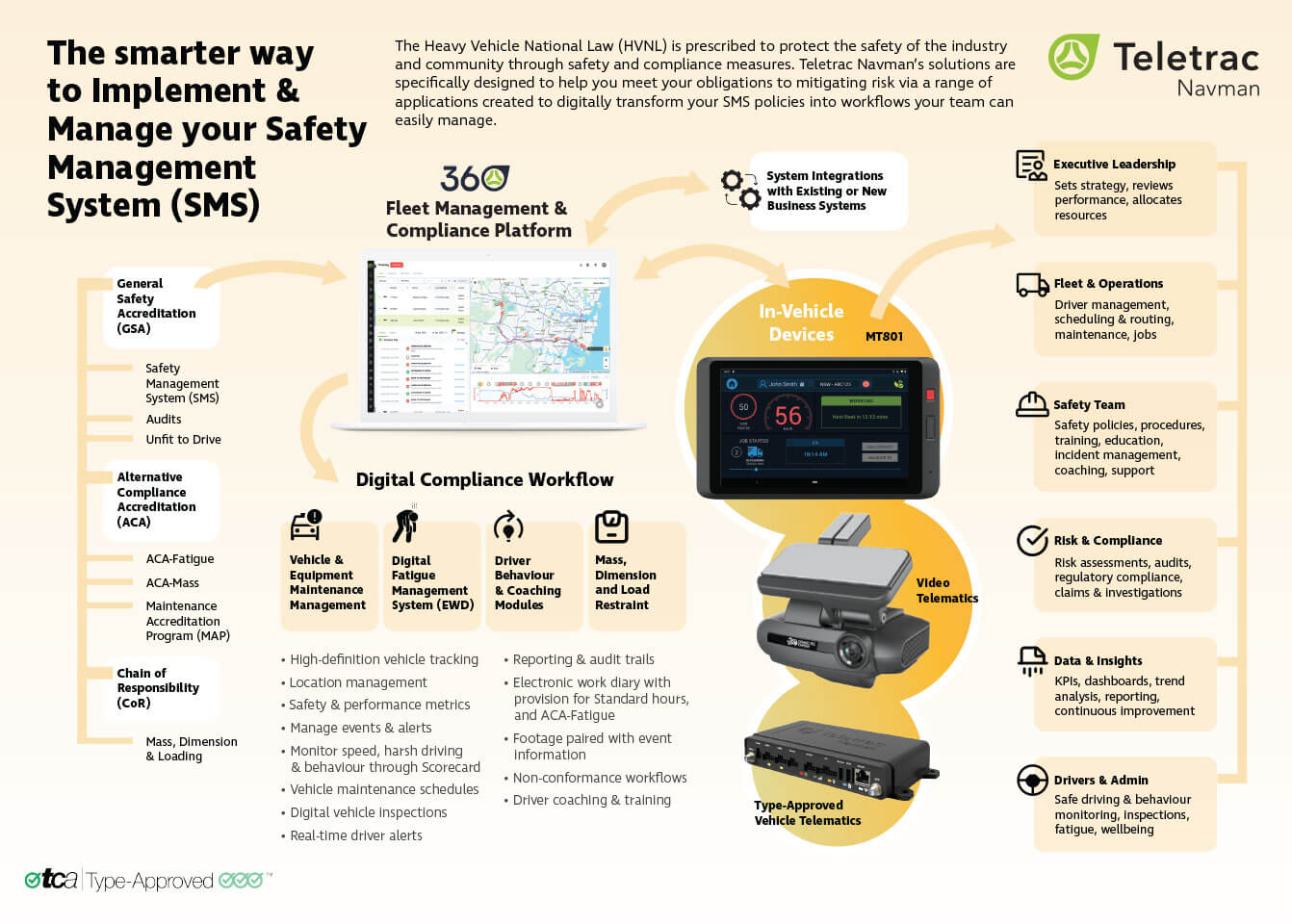
Get in touch with our team today on how you can benefit from technology to manage your SMS requirements.